

How We Use AI
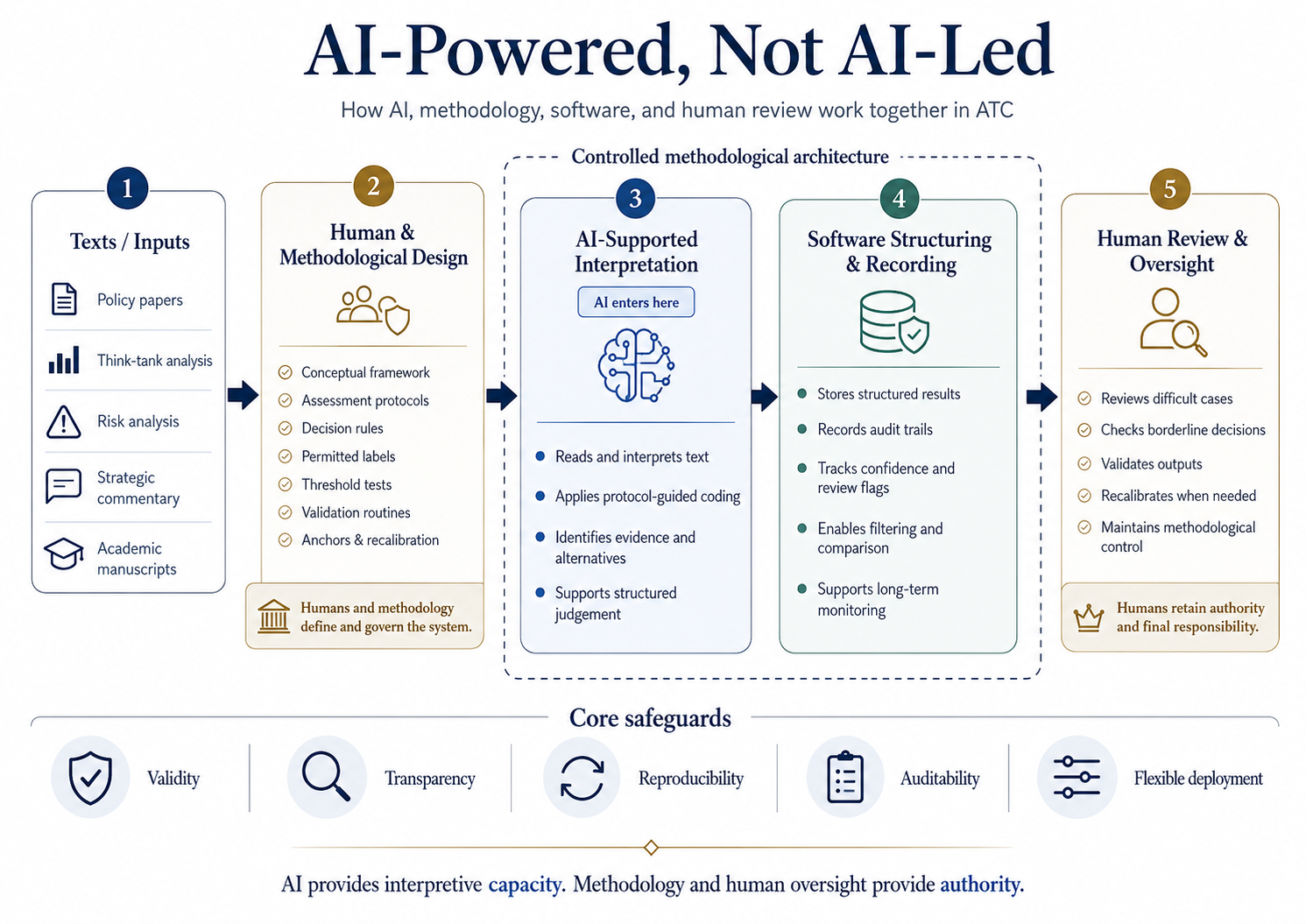
AI provides interpretive capacity. Methodology provides authority. Humans provide judgement and responsibility.
Core Safeguards
Analysis Excellence uses AI as an interpretive instrument within a controlled methodological system. Our assessments are AI-powered, but not AI-led: models do not independently determine what constitutes good analysis, assign unrestricted judgements, or define the standards against which texts are assessed. In ATC, AI operates within a structured architecture. Its role is to support the interpretation and coding of complex qualitative material at a scale and consistency that would otherwise be difficult to achieve.
Methodological Control: The principal safeguard is that AI operates within predefined analytical boundaries. Assessment protocols specify what is being evaluated, how decisions should be reached, which categories and scores are permissible, what evidence is required, how borderline cases should be treated, and when human review or recalibration is necessary. Across both ATC modules, the current implementation contains approximately 3,578 granular executable decision nodes: 2,547 in EAA and 1,031 in AMD, with about 3,075 belonging directly to substantive analytical and governance logic. EAA is governed by a formal registry of 300 rules, while AMD is built around 55 canonical quality constructs applied through 12 family contracts, producing 478 family-specific score-bearing criterion instances across the routing system. Because each score-bearing AMD criterion can resolve to one of five raw judgement states, these 478 instances generate 2,390 criterion-state alternatives before routing, applicability, boundary, finalisation, replication and batch-governance decisions are added. The architecture therefore operates through several thousand distinct decision points and state alternatives rather than simply “300 rules” in EAA or “55 decisions” in AMD. This limits unconstrained model judgement and ensures that the assessment remains governed by the methodology rather than by the preferences, assumptions, or variability of an AI system.
Validity: AI-supported assessment is only useful if it measures what the methodology intends it to measure. Validity is therefore built into the architecture through explicit conceptual definitions, operational criteria, decision sequences, threshold rules, anchors, boundary tests, validation routines, and recalibration procedures. The objective is not simply to obtain a plausible AI response, but to ensure that every assessment corresponds as closely as possible to the underlying analytical construct.
Transparency: AI-supported judgements should be inspectable rather than opaque. ATC is designed to record not only the resulting classification, score, route, or diagnostic flag, but also the grounds upon which the decision was made. Relevant textual or structural evidence, competing interpretations, threshold decisions, boundary checks, and uncertainty can therefore be retained alongside the result.
Reproducibility: Qualitative judgement inevitably contains interpretive complexity. Our methodology is designed to reduce unnecessary variation by requiring assessments to follow the same conceptual definitions, coding rules, decision sequences, thresholds, and validation procedures. Repeated assessment should therefore be governed by the same methodological architecture rather than by unconstrained model discretion.
Auditability: Every important assessment decision should be capable of retrospective examination. ATC therefore maintains structured records of assessment outputs and, where applicable, the reasoning, evidence, confidence, review flags, validation results, and recalibration history associated with them.
Flexible Deployment: The methodology is designed to remain independent of any single AI provider or deployment model. Depending on institutional requirements, ATC can operate through supported external AI-provider access or through a configured local AI environment.
-
AI is used because the relevant judgements require close reading across many texts, consistent attention to structure, and repeated application of complex criteria. Without software support, these assessments are difficult to scale, compare, and audit. The role of AI is to assist the reading and classification process, while the methodology determines what may count as a valid assessment.
-
The system restricts the AI through fixed concepts, permitted labels, staged prompts, output schemas, threshold rules, and validation checks. It cannot legitimately create its own categories, invent a new scoring logic, or replace the protocol with a general impression. A result is useful only when it can be traced back to the relevant decision path.
-
Each major judgement is accompanied by an explanation of the grounds on which it was made. The system records the textual or structural basis for a classification, the relevant alternatives, and the reason why one interpretation was selected over another. This is especially important for boundary cases, where a small difference in interpretation can change the final result.
-
Reproducibility does not mean that every sentence of an AI-generated explanation will always be identical. It means that the structured result should remain stable where the same text is assessed under the same method: the same route, category, score logic, confidence position, review flag, or diagnostic pattern should be recoverable and auditable.
-
Running the system with a local AI model can be useful for institutions with stricter data-governance or operational preferences. It changes the deployment environment, not the method. The same protocols, checks, fields, and review expectations remain in force whether the system is connected to an external provider or a local model.
-
Human review is most important where results are close to a boundary, where confidence is lower, where the system flags contradiction or drift, or where an institution intends to rely on results for training, publication strategy, or quality assurance. The software structures the judgement; it does not remove responsibility for interpreting and using it.
Interested in exploring ATC beyond the standard free trial?
Through our ATC Joint Development Programme, selected individual and institutional users can test EAA, AMD or both modules on a structured batch of real analytical or scholarly work, provide substantive written feedback, and receive a complimentary two-month licence for the module or modules successfully tested. Participation is selective and available once per customer.
Click the button below to learn more about the ATC Joint Development Programme and apply to participate.
Have you installed ATC but are unsure how to configure the AI connection — or would you like to understand the setup in advance?
The ATC AI Integration Guide explains how to configure the OpenAI API or LM Studio, obtain and securely use an API key, select an appropriate local model, and match local AI use to your computer’s capacity. It also covers privacy, reproducibility and recommended configurations for professional and institutional use. Download the guide for clear, step-by-step setup instructions.