

Our Offerings
Our offerings form a structured progression from assessing analytical work, to strengthening analytical practice, to building internal monitoring systems, and supporting long-term analytical strategy at the institutional level. Together, they provide a rigorous and coherent framework for developing analytical excellence over time.

Analytical Performance Review
-
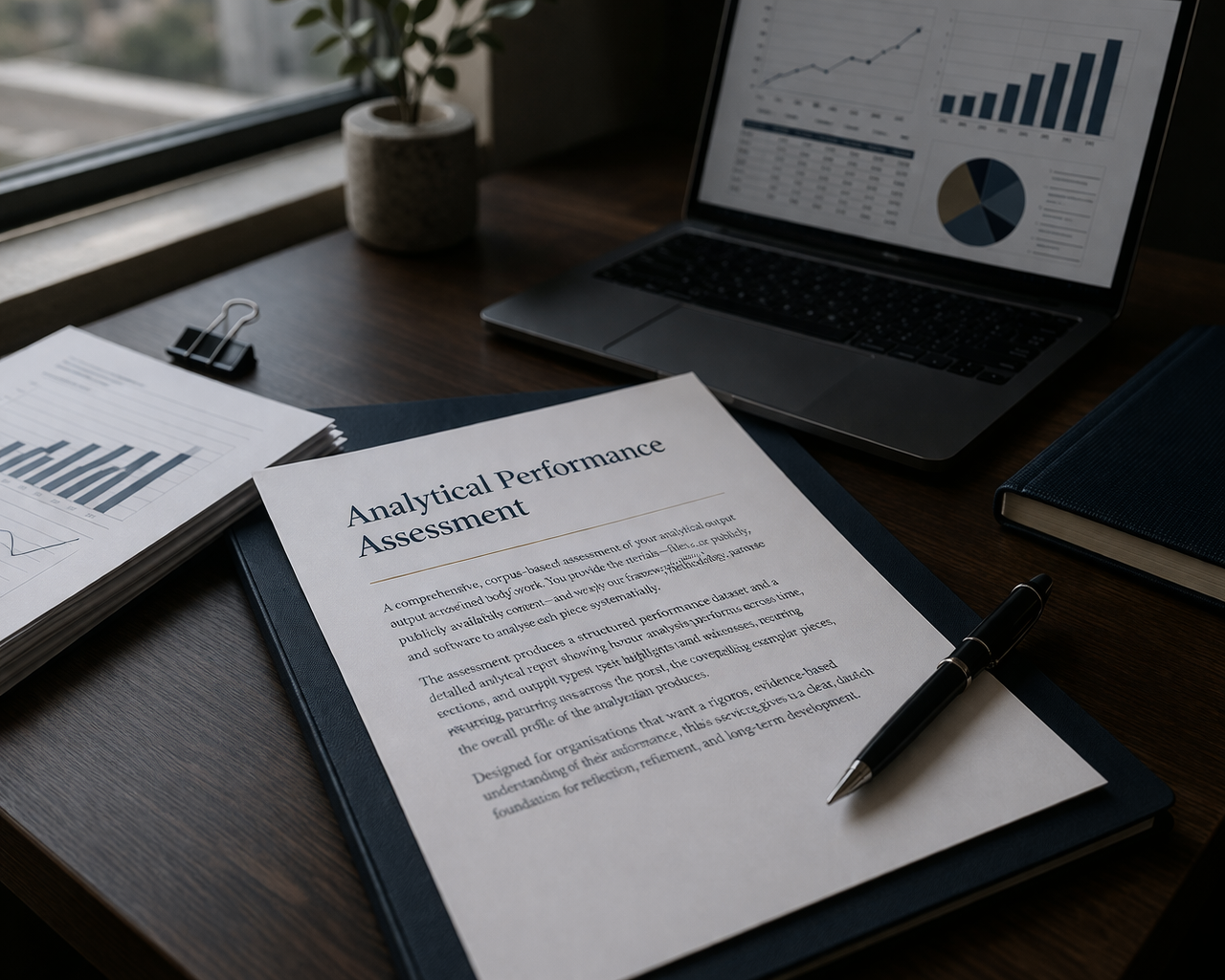
Structured review of your organisation’s analytical output across a body of publications, formats, and teams in order to identify patterns, strengths, recurring limitations, and overall analytical profile.
-
A structured performance dataset and an analytical report interpreting key patterns, strengths, weaknesses, and areas for development.
-
A clear institution-level understanding of analytical performance over time, a foundation for internal monitoring, and an evidence base for further development work.
The Analytical Performance Review provides organisations with a structured understanding of how their analytical work performs as a body of institutional output. Rather than focusing on individual texts in isolation, the review examines analytical work across a wider body of publications in order to identify patterns, strengths, recurring limitations, and the overall analytical profile of the organisation’s work. The purpose of the review is to move beyond general impressions and provide a clearer, more systematic understanding of analytical performance over time. It helps organisations see what kind of analysis they produce most often, where their analytical work is strongest, where structural limitations appear, and how analytical performance varies across teams, sections, and publication formats.
The review results in two main outputs: a structured performance dataset and an analytical report. The dataset provides a long-term foundation for internal monitoring and future comparison, while the report provides a clear interpretation of the organisation’s analytical profile, including strengths, recurring patterns, and areas for development. For many organisations, analytical work is a central institutional product, yet analytical quality is rarely examined in a structured way across a full body of work. The Analytical Performance Review fills this gap by providing a systematic, institution-level view of analytical performance and a foundation for analytical development over time.
The review often becomes the starting point for further work, including tailored workshops, internal system development, software implementation, and longer-term cooperation focused on strengthening analytical performance at the organisational level.
“What cannot be seen systematically cannot be improved strategically.”
Tailored Analytical Development Workshop
-
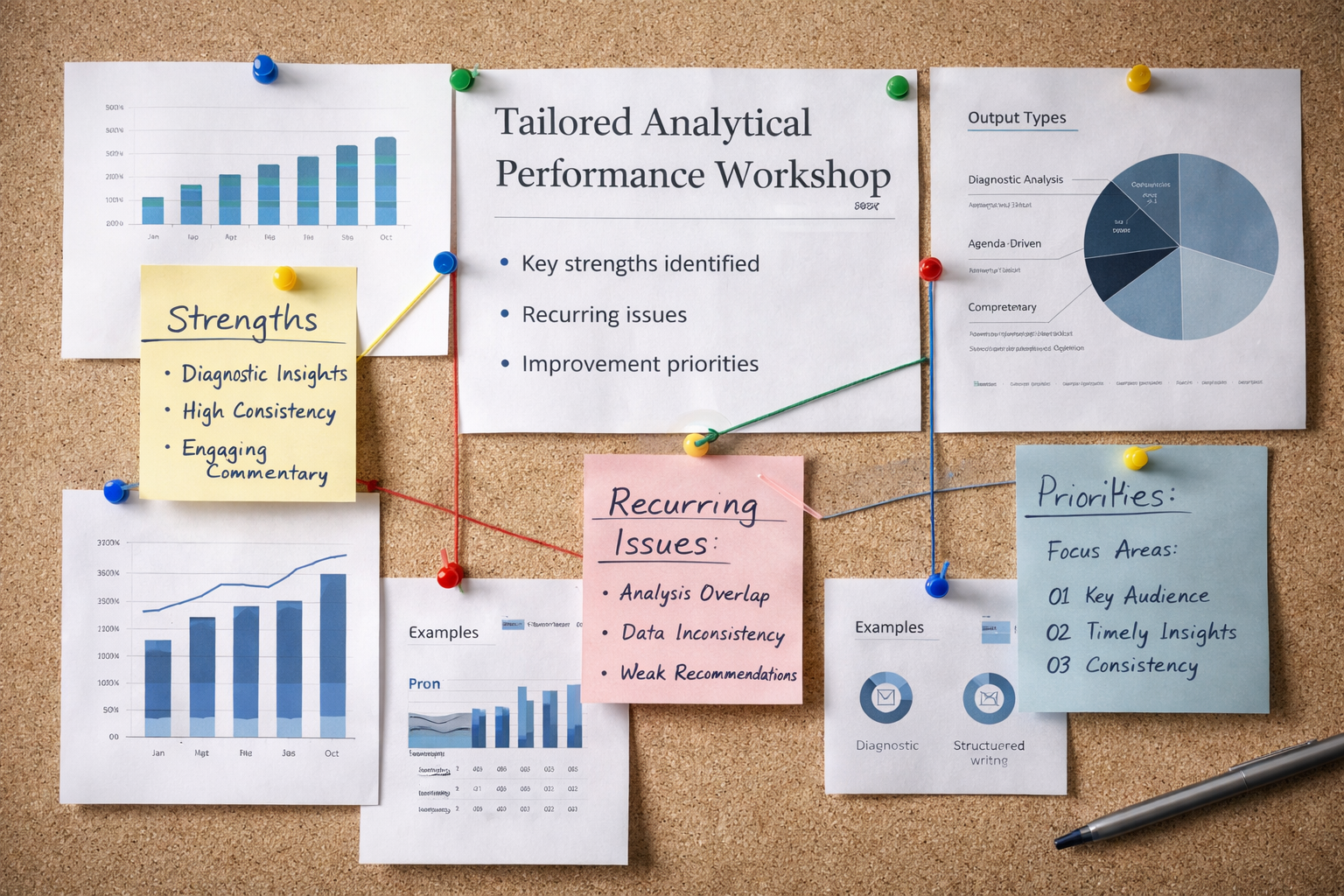
A bespoke workshop designed in direct response to the findings of the Analytical Performance Review and focused on the specific strengths, weaknesses, and recurring patterns in your organisation’s analytical output.
-
A targeted workshop programme built around your institution’s analytical profile, supported by examples, practical reflection, and applied discussion.
-
Stronger institutional learning, clearer understanding of recurring analytical tendencies, and more focused improvement in future analytical practice.
A bespoke workshop developed in direct response to the findings of the analytical performance assessment and grounded in the conceptual framework and methodology behind our work. Rather than offering generic training, this workshop is designed around the actual strengths, weaknesses, recurring patterns, and developmental needs identified in your organisation’s analytical output. It translates the results of the assessment into a focused, practical learning format for executives, editorial leads, analysts, researchers, or wider teams.
The workshop is structured to address the specific profile of your institution’s analytical production. Depending on the findings, this may include recurring issues in reasoning, evaluative framing, analytical balance, consistency across sections or formats, variation in performance over time, or the relationship between stronger and weaker exemplar pieces. In this sense, the workshop is not simply an introduction to abstract principles of good analysis. It is a targeted intervention built on evidence generated from your own corpus of work.
Because it is grounded both in the assessment results and in the underlying conceptual architecture of our approach, the workshop helps participants understand not only where patterns of strength and weakness lie, but why those patterns matter and how they can be addressed in practice. This makes it particularly useful for organisations seeking to move from diagnosis to institutional learning. It can be designed for senior leadership, editorial or managerial staff, analytical teams, or mixed internal audiences, depending on whether the priority is strategic oversight, team development, or the improvement of day-to-day analytical practice.
The aim of the workshop is to turn assessment into action: to help organisations reflect on their own analytical habits, recognise recurring tendencies in their output, and strengthen the quality and consistency of future work in a way that is both methodologically grounded and institutionally relevant.
“The most effective analytical development begins where your own patterns become visible.”
A comprehensive workshop introducing the analytical framework, criteria, and logic that underpin our work. Unlike the tailored workshop, this offering does not depend on a prior analytical performance assessment and can be delivered independently or repeated over time as part of long-term analytical development. It can also complement the Tailored Analytical Performance Workshop by providing a deeper and more systematic understanding of the analytical principles behind the assessment.
This workshop focuses on what makes analysis analytical. It does not focus primarily on writing style or presentation, but on the structure of analysis itself: how arguments are formed, how reasoning constrains conclusions, how evaluative commitments interact with analytical judgement, and how different types of analytical work differ in structure and purpose. The workshop introduces participants to the core dimensions of the framework, including reasoning, evaluation, and the relationship between them, and shows how these translate into different types of analytical output.
Although the workshop is grounded in a strong conceptual and theoretical framework, it is not a theoretical seminar. The emphasis is on practical analytical work: how analysis is constructed, how it can be assessed, how different analytical forms operate in practice, and how stronger analytical structure can be implemented in day-to-day analytical production. Participants work with examples, structures, and practical analytical decomposition rather than abstract discussion alone.
This workshop is particularly useful for organisations that want to develop a shared internal understanding of analytical standards, strengthen analytical practice across teams, train new analysts, or build a more consistent analytical culture over time. It can be delivered as a standalone workshop, as part of a longer-term development programme, or in combination with assessment and tailored workshops.
“Strong analysis is not an instinct; it is a structure that can be learned.”
Core Analytical Development Workshop
-
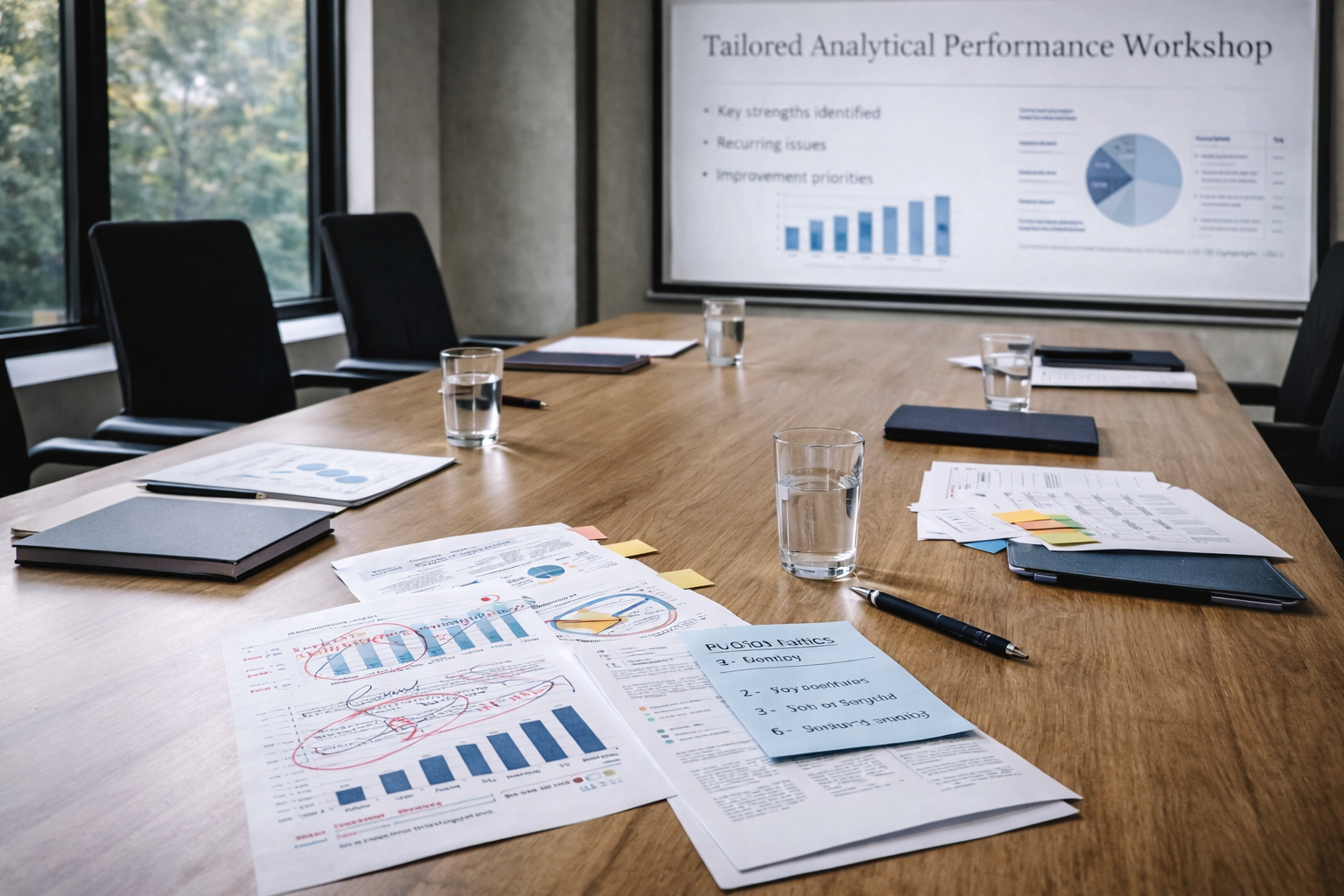
A comprehensive workshop introducing the framework, criteria, and logic of analytical work, with emphasis on how analysis is structured, assessed, and strengthened in practice.
-
A structured training session built around core analytical concepts, practical examples, and analytical decomposition exercises.
-
A shared understanding of analytical standards, stronger day-to-day analytical practice, and a more consistent analytical culture across teams.
Our Signature Software: Analysis Typology Coder

-
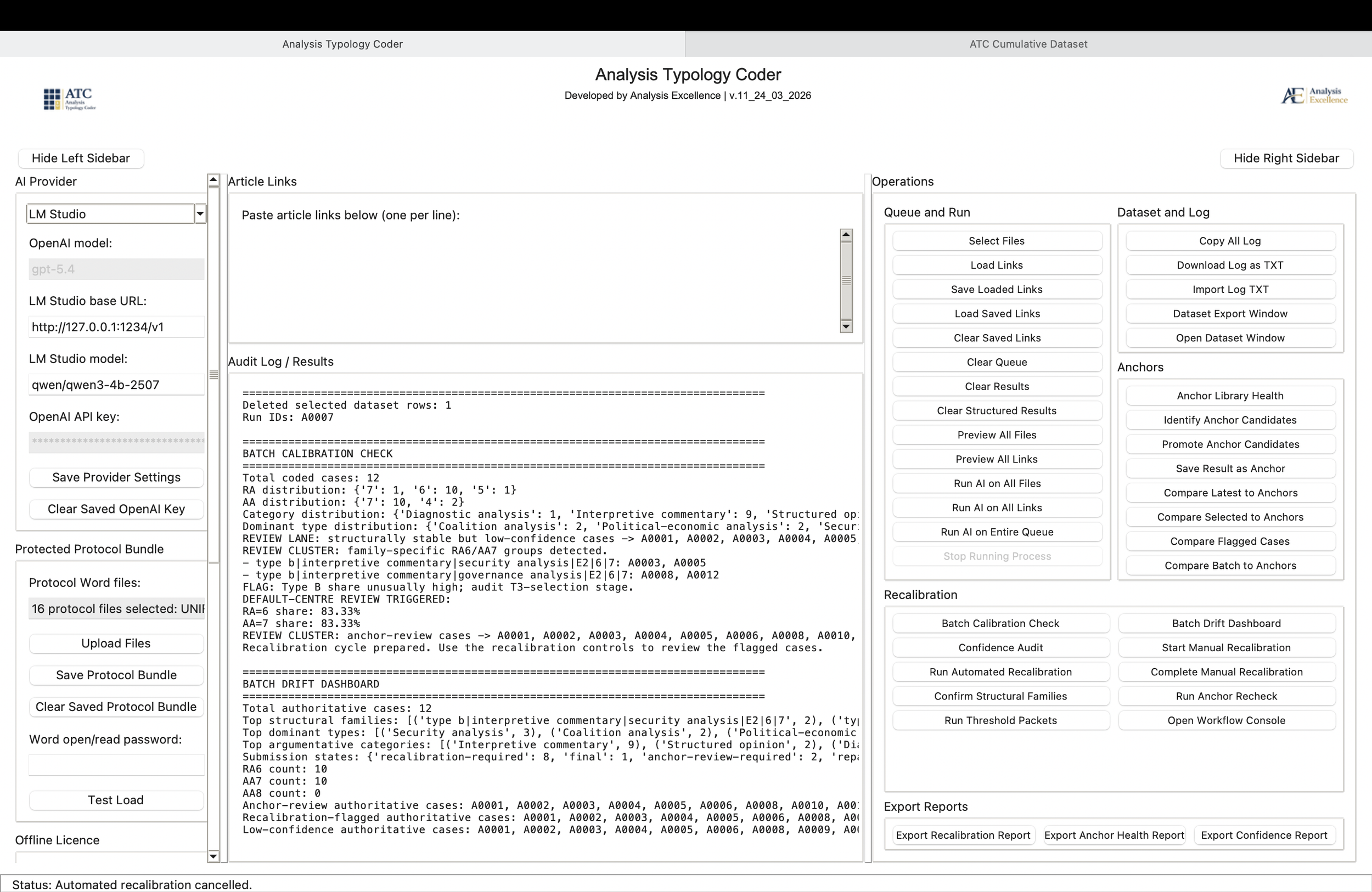
A specialised software environment installed in client’s premises for the structured assessment of full analytical texts; client is trained in how to use the software; hands-on support is provided for 1/3 of the licence period.
-
A licensed assessment system, cumulative dataset, exportable reports, audit logs, review tools, benchmark management features, user guide, and training.
-
More consistent, reproducible, and auditable assessment of analytical work, stronger internal monitoring capacity, and a documented basis for long-term analytical development.
Our software is a specialised analytical assessment environment developed on the basis of our conceptual framework, methodology, and operational protocols. It is not a generic text-analysis or summarisation tool. Instead, it is designed specifically for the structured assessment of full analytical texts and for the generation of a cumulative dataset on analytical performance over time.
The software allows users to process analytical texts as files or links, run structured assessments, store results in a cumulative dataset, and export structured data and reports for further institutional use. The system is built around a fixed analytical structure and a rule-based protocol, which ensures that assessments are conducted in a consistent, reproducible, and auditable way rather than through impressionistic reading alone.
One of the key features of the software is that it does not simply produce text outputs. It builds a structured dataset that can be filtered, reviewed, exported, and analysed over time. Users can examine their analytical output across different categories, track patterns and changes, identify stronger and weaker pieces, and maintain an internal performance record of analytical work across months and years.
The software also includes review and quality-control tools that allow users to revisit earlier results, document revisions, maintain audit logs, export reports, and manage benchmark cases. This makes it particularly suitable for organisations that want to build a consistent internal analytical standard and maintain a documented analytical record rather than relying on informal editorial judgement alone.
The software is offered under licence and is available to clients after the completion of an Analytical Performance Assessment. This ensures that users first become familiar with the framework, methodology, and interpretation of results before using the system independently. The licence includes the software, a detailed user guide, and training on how to use the system and how to interpret the results in a methodologically consistent way.
The aim of the software is not to replace analytical judgement, but to provide a structured environment in which analytical work can be assessed, documented, compared, and developed over time in a consistent and methodologically grounded way.
The software is designed to be useful both for those who produce analysis and for those who lead analytical organisations. For analysts and researchers, it provides a structured environment for reviewing work, understanding analytical standards, and tracking development over time. For executives, editorial leads, and managers, it provides a structured overview of institutional analytical performance, making it easier to supervise analytical work, maintain consistent standards, and make more informed decisions about training, recruitment, editorial direction, and long-term institutional development.
“Rigour becomes sustainable when judgement is supported by structure.”
Excellence Partnership
The Excellence Partnership is a long-term institutional cooperation designed for organisations that want to develop, monitor, and steer analytical performance at the institutional level. While the assessment, workshops, and software focus on performance measurement and analytical development at the level of individual texts and teams, the Excellence Partnership operates at the level of institutional strategy and leadership.
This partnership supports executives and organisational leadership in designing and implementing structured approaches to analytical performance monitoring, evaluation, and development. It includes support in defining analytical standards, developing performance indicators, designing internal evaluation procedures, and building a consistent framework for monitoring analytical output over time. The aim is to help organisations move from occasional assessment to a structured and continuous approach to analytical performance as an institutional function.
The partnership may include regular analytical performance reviews, support in interpreting performance data, advisory input on analytical development strategy, and executive-level discussions on how analytical work aligns with institutional goals, reputation, and long-term positioning. It is particularly useful for organisations that produce analytical work as a core institutional product and want to manage analytical quality and development in a structured and strategic way.
In essence, the Excellence Partnership is not a single service, but an ongoing cooperation focused on helping organisations build, maintain, and lead analytical excellence as an institutional capability.
Together, the earlier offerings form a continuous cycle: analytical work is assessed and measured, the results are interpreted and understood, teams are trained on this basis, and organisations build internal systems to continue monitoring and development. The Excellence Partnership supports this final stage by working with leadership to translate measurement, training, and systems into institutional standards, strategic direction, and sustained analytical development.
-
A long-term institutional cooperation supporting leadership in designing, implementing, and steering structured systems for analytical performance monitoring and development.
-
Strategic advisory support, regular performance reviews, guidance on standards and indicators, internal evaluation design, and leadership-level interpretation of analytical performance data.
-
Analytical excellence becomes an institutional capability rather than a one-off exercise, supported by clearer standards, stronger oversight, and sustained long-term development.

“Analytical excellence becomes durable when it is built into the institution, not left to individuals alone.”